
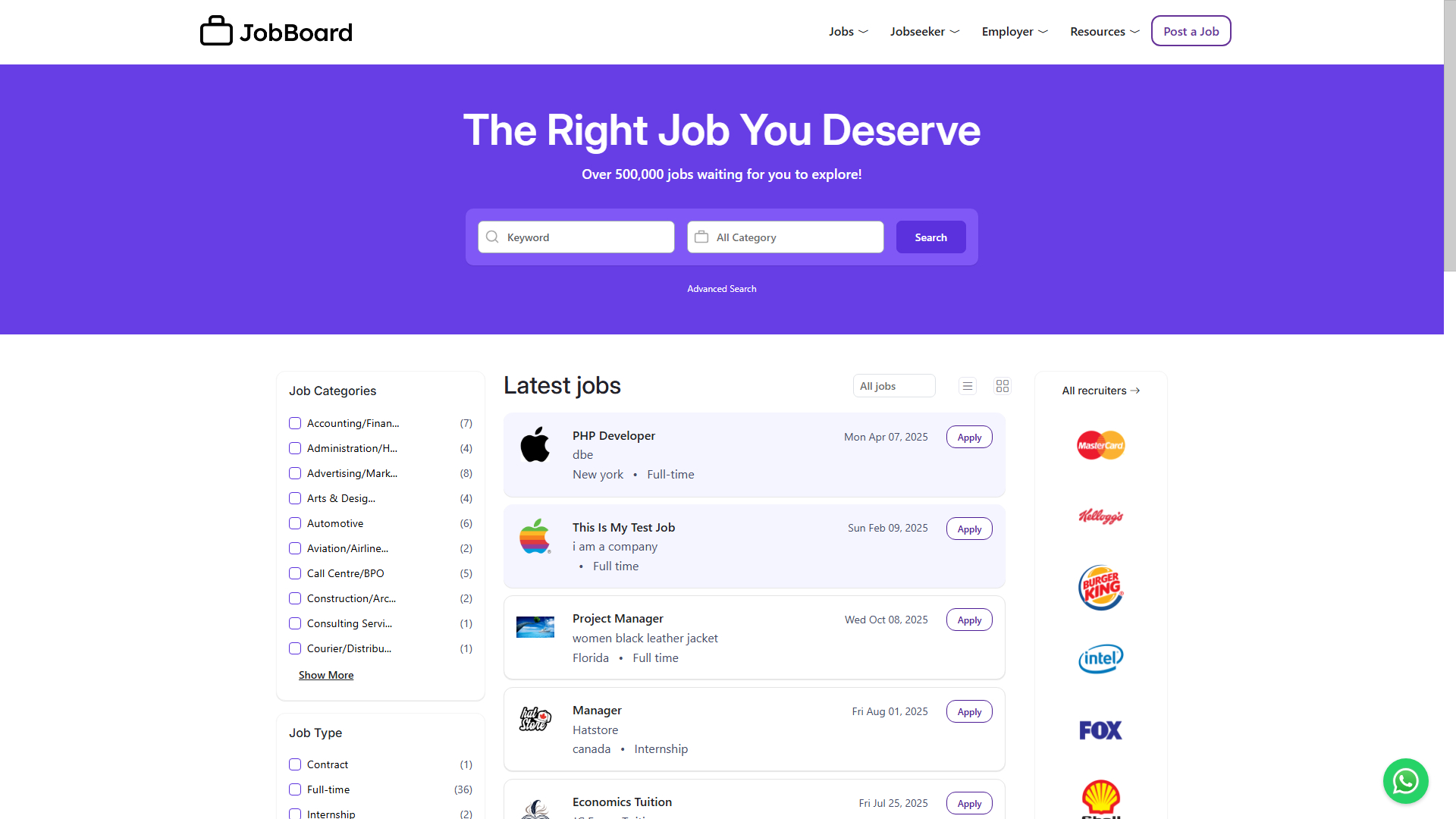
If you have ever thought, “I could build a job site for my industry,” you are not alone. Hiring is constant, companies want qualified candidates faster, and job seekers want fewer irrelevant listings.
That gap creates an opportunity for a focused job board that serves one audience extremely well.
The good news: you do not need to code a job marketplace from scratch anymore. Modern job board software lets you launch faster with essential features like job posting, search filters, company profiles, alerts, payments, analytics, and integrations.
In this guide, you will learn how to launch a job board step by step, choose the best job board platform for your use case, add monetization, and build an SEO-driven marketing engine that grows month after month.
What is job board software and why it matters
Job board software is the system that powers your job board website. It typically includes:
- A front-end job listings experience (search, filters, job detail pages)
- Employer tools (post jobs, manage listings, view applicants)
- Job seeker tools (profiles, resumes, saved jobs, alerts)
- Admin tools (moderation, pricing, featured listings, analytics)
- Payments and billing (packages, subscriptions, invoices)
- Integrations (email, CRM, ATS, analytics, webhooks)
Why it matters: your job board is a product. The software determines how fast you can launch, how stable the site is, how easily you can monetize, and how well you can compete in search.
Practical reality check
Job marketplaces are big. In the U.S., job openings can stay in the millions, and employment projections still show long-term movement in the market. The Job Openings and Labor Turnover Survey (JOLTS) reported 7.7 million job openings in October 2025. Total employment is also projected to increase by 5.2 million from 2024 to 2034, according to the U.S. Bureau of Labor Statistics employment projections.

Authoritative sources you can reference:
https://www.bls.gov/news.
https://www.bls.gov/emp/
https://data.worldbank.org/
Step 1: Choose a profitable niche (the most important decision)
Most new job boards fail for one reason: they try to be a generic “jobs for everyone” website. Competing with global job aggregators is expensive and slow.
A niche job board wins by focusing on a clear audience, with clear language, and clear value.
High-demand niche ideas
Pick a niche where hiring is constant, qualifications are specific, and employers are willing to pay for better candidates.
Examples:
- Healthcare roles in a city or state
- Remote customer support roles
- Cybersecurity jobs
- Sales and CRM jobs
- Trades and construction jobs
- Education and tutoring jobs
- Renewable energy and sustainability roles
- Startup and SaaS jobs
- Hospitality jobs for a tourist region
How to validate your niche quickly
Use this simple validation plan:
- Demand check
- Search Google for “your niche + jobs” and note how many companies are hiring.
- Check LinkedIn and company career pages.
- Employer willingness to pay
- Look for existing paid job boards in the niche.
- Check whether recruiting agencies are active.
- Candidate supply
- Identify where candidates gather: communities, newsletters, forums, groups.
- Differentiation
- Define your unique promise in one sentence.
Example promise:
“A curated job board for remote customer support roles with verified companies and weekly salary insights.”
Step 2: Decide your job board business model
A job board is not just a website. It is a marketplace. You need a model that creates value for employers and job seekers.
Common models:
Free for job seekers, paid for employers
This is the most common approach.
Ways to charge employers:
- Pay per job post
- Job post packages (5 posts per month)
- Featured listings (add-on upsell)
- Subscriptions (monthly or yearly)
Sponsored employer profiles
Sell enhanced company pages:
- Logo placement
- “Hiring now” badge
- Unlimited posts
- Featured placement in category pages
Lead generation for recruitment or services
You can use the job board as a lead engine:
- Recruiting services
- HR software and ATS referrals
- Resume writing and career coaching
Candidate access (resume database)
Charge employers for access to candidate profiles and resumes.
Important: if you operate in regions with privacy laws, make sure your data handling is compliant.
Step 3: Choose the right job board platform
There are three main ways to launch:
Option A: Hosted job board platforms like hiregen.com
Best for: fastest launch, minimal tech.
Pros:
- Quick setup
- Hosting and updates handled
- Built-in templates
Cons:
- Less customization
- Monthly costs
Option B: Open-source or self-hosted job board software like ejobsitesoftware.com
Best for: more control, custom features.
Pros:
- Full control
- Custom workflows
- Flexible integrations
Cons:
- Requires maintenance
Option C: WordPress job board plugin + theme like wpnova.com
Best for: content + SEO-driven growth with flexibility.
Pros:
- Powerful blogging and SEO
- Huge plugin ecosystem
- Easier customization than custom builds
Cons:
- Needs performance and security best practices
Checklist: job board software features you should not skip
For a strong launch, prioritize:
Core job marketplace features
- Job posting form with fields (title, salary, location, job type)
- Job search with filters (location, category, type, remote)
- Job detail pages optimized for SEO
- Company profiles
- Saved jobs and bookmarks
- Job alerts (email notifications)
Employer experience
- Employer dashboard
- Manage active and expired jobs
- Applicant tracking (even basic status updates)
- Invoicing and payment history
Admin experience
- Approve or reject job posts
- Pricing and package management
- Featured and promoted listings
- Analytics dashboard
Monetization and growth
- Stripe and PayPal (or local payment options)
- Coupon codes
- Subscription billing
- Blog and landing pages
Trust and compliance
- Terms, privacy policy, and cookie consent
- Anti-spam protection
- Basic security (rate limiting, validation, reCAPTCHA)
Step 4: Plan your website structure for SEO from day one
A job board lives and dies by search visibility. If you build the structure correctly, every job post becomes a potential entry point.
A simple SEO-friendly site map
Keep it clean and predictable:
- Home
- Jobs (search results)
- Job categories
- Locations
- Companies
- Post a job
- Pricing
- Blog
- About
- Contact
SEO URL patterns that work
Examples:
/jobs/
/jobs/category/customer-
/jobs/location/bengaluru/
/company/acme-inc/
/job/remote-customer-support-
On-page SEO basics for job boards
- Use one H1 per page
- Add clear meta titles and descriptions
- Include salary ranges when possible
- Use internal links between categories, locations, and companies
- Avoid thin pages (pages with no listings should be handled carefully)
Structured data (schema) you should use
Job boards should strongly consider:
- JobPosting schema on job detail pages
- Organization schema on company pages
- Breadcrumb schema for navigation
Google reference:
https://developers.google.com/
Step 5: Build your minimum viable job board (MVP)
Do not try to launch with everything.
Launch an MVP that does three things well:
- Employers can post jobs easily
- Candidates can find relevant jobs quickly
- You can get paid
The MVP feature set
- Job posting (with moderation)
- Job search + filters
- Categories and locations
- Pricing page with 2 to 3 packages
- Payment gateway
- Employer and candidate login
- Basic email notifications
- Blog section for content marketing
What to delay until version 2
- Resume builder
- Complex ATS automation
- AI features
- Multi-language support
- Advanced reporting
Step 6: Set pricing that employers actually buy
Pricing is not just math. It is positioning.
A practical starting point:
Package-based pricing example
Starter
- 1 job post
- 30-day duration
- Standard placement
Growth
- 5 job posts
- 60-day duration
- Email blast to subscribers
- Basic applicant management
Pro
- Unlimited posts
- Featured placement
- Company profile upgrade
- Priority support
Featured listing add-ons (high-margin)
- Featured in search results
- Highlighted in category pages
- Pinned to top for 7 days
Offer a limited-time launch deal
To get early traction:
- First job post free for verified employers
- 50% off for the first 30 days
- Bundle “featured” as a bonus
Step 7: Get your first 50 employers and 500 candidates
This is where most people feel stuck. But the first traction is not about ads. It is about direct outreach and partnerships.
How to get employers (realistic tactics)
- Build a target list
- 100 companies in your niche and region
- HR emails, LinkedIn pages, career pages
- Offer a founder deal
- Free posting for 30 days in exchange for feedback
- Partner with communities
- Industry associations
- Local groups
- Training institutes
- Use a simple outreach script
Employer message sample:
Subject: New niche job board for [industry] hiring
Hi [Name],
I am building a focused job board for [niche] roles. We verify companies and promote jobs to a targeted audience.
Would you like to post your next opening for free during our launch month? If it performs, we can share our paid plans.
Thanks,
[Your Name]
How to get candidates
- Post valuable content weekly
- Offer job alerts and a weekly email digest
- Share curated jobs in relevant groups
- Create location pages and category pages
Step 8: Create content that ranks and converts
A job board that relies only on job listings is fragile. A job board with strong content becomes an authority site.
Content ideas that attract job seekers
- Salary guides by role and location
- Resume and interview tips for the niche
- Career roadmaps (skills, certifications, timelines)
- “Best companies hiring” roundups
- Remote work guides
Content ideas that attract employers
- Hiring templates (job descriptions)
- Interview question libraries
- Hiring trend insights for the niche
- Employer branding tips
A simple content calendar (first 8 weeks)
Week 1: “Top roles hiring in [niche] in 2026”
Week 2: “Salary guide: [role] in [location]”
Week 3: “How to write a job description for [role]”
Week 4: “Interview questions for [role]”
Week 5: “Skills checklist for [role]”
Week 6: “Best companies hiring [role]”
Week 7: “Remote vs onsite: what employers want”
Week 8: “Career roadmap: beginner to senior in [niche]”
Step 9: Add retention features to grow recurring traffic
You want users to return without you chasing them.
Retention features that matter:
- Email job alerts by keyword
- Weekly job digest newsletter
- Saved searches
- Follow companies
- Application tracking (even basic)
Tip: your email list becomes your strongest growth asset.
Step 10: Track metrics that show real progress
Ignore vanity metrics and focus on marketplace health.
Key job board KPIs
Supply metrics (employers)
- Number of active paying employers
- Job posts per employer per month
- Revenue per employer
Demand metrics (candidates)
- Job seeker sign-ups
- Search-to-apply rate
- Email subscribers
- Returning visitors
Marketplace quality
- Time to first qualified applicant
- Job fill rate (if you can track it)
- Employer satisfaction
Step 11: Compliance, trust, and quality control
Trust is your moat.
Essential legal pages
- Terms of service
- Privacy policy
- Refund policy (for paid listings)
- Cookie policy (if required)
Anti-spam and fraud protection
- Email verification
- reCAPTCHA on forms
- Manual review for first-time employers
- Clear rules on prohibited content
For guidance on data privacy and user rights, review:
Step 12: Launch checklist (copy and use)
Pre-launch
- Choose niche and define your one-sentence promise
- Set up branding (logo, colors, tone)
- Configure job board software features
- Create pricing packages and payment gateway
- Publish legal pages
- Build category and location structure
- Set up job alerts and email digest
Launch week
- Add 50 to 200 seed listings (manual or partner-supplied)
- Reach out to 100 employers with founder deal
- Publish 3 strong content pieces (guides, salary, interview)
- Post curated jobs in 5 communities
- Collect feedback and fix friction points
Post-launch (first 30 days)
- Improve SEO internal linking
- Add schema and structured data validation
- Optimize conversion on pricing page
- Add testimonials and case studies
- Turn top content into lead magnets
Common mistakes to avoid
- Launching without a niche
- Waiting for “perfect features” before going live
- Not having a clear monetization plan
- Ignoring SEO structure until later
- Letting low-quality or scam listings through
- Not collecting emails from day one
Practical examples of job board positioning
Here are three positioning styles you can copy:
Example 1: Curated niche + verified companies
“We list only verified companies hiring [niche]. No spam, no duplicates.”
Example 2: Local-first + fast hiring
“The fastest way to hire [role] in [city]. Post today, get applicants this week.”
Example 3: Premium talent + high-quality applicants
“Premium candidates for premium roles. Screening built into the process.”
How long does it take to launch a job board
With modern job board software, a focused MVP can be launched quickly when you keep the scope tight.
A practical timeline:
- Week 1: niche, brand, platform selection, structure
- Week 2: configure features, pricing, payments, pages
- Week 3: seed listings, outreach, initial content
- Week 4: refine based on feedback and push marketing
Your results depend more on outreach and content consistency than on perfect technology.
Step 13: Build credibility with social proof and verification
Early-stage job boards feel “empty” unless you design for trust.
Ways to build credibility fast:
- Verified employer badge
Require a business email and review the company website before approving the first job post. - Transparency on listings
Display job post date, expiration date, job type, location (or remote), and salary range when provided. - Simple quality rules
Reject jobs with vague titles, missing responsibilities, or misleading compensation. - Showcase results
Add small proof points on your homepage:
“New jobs added weekly,” “Companies verified,” “Curated listings,” “Newsletter subscribers.” - Testimonials
Collect short quotes from employers after they receive their first applications.
Step 14: Promotion channels that work for job boards
You do not need to be everywhere. Pick 2 to 3 channels and become consistent.
1) SEO (your compounding growth engine)
SEO for job boards is different from SEO for blogs because you have many pages that change frequently. Focus on stable pages that can rank for months:
- Category pages
Example: “Customer Support Jobs” - Location pages
Example: “Customer Support Jobs in Bengaluru” - Company pages
Example: “Acme Inc Careers” - Evergreen content
Example: salary guides, skills roadmaps, interview prep
A practical internal linking system:
- Home links to top categories and locations
- Category pages link to top locations and related categories
- Job detail pages link back to their category, location, and company
- Blog posts link to relevant category and location pages
2) Newsletter and email marketing (highest ROI)
A job board email list is pure leverage.
Start with two simple campaigns:
- Weekly job digest
A curated email with the best new listings. - Job alerts
Automated emails based on keywords or categories.
Email best practices:
- Ask users to choose categories and locations on signup
- Keep the email short and scannable
- Use clear subject lines like “12 new remote support jobs this week”
3) Partnerships
Partnerships are the fastest path to distribution.
Good partners:
- Training institutes and bootcamps
- Industry associations
- Local communities and meetups
- Podcasts and niche newsletters
Offer a win-win:
- Discounted postings for partner companies
- Co-branded job digest
- Sponsored hiring guide
4) Social distribution (without burning time)
Instead of daily random posts, use a repeatable format:
- Monday: “Top 5 jobs this week”
- Wednesday: “Skill tip for [role]”
- Friday: “Salary snapshot”
This keeps your marketing light but consistent.
Step 15: Budgeting and operating costs
Your costs depend on the platform, traffic, and team size. A simple way to think about it:
One-time setup costs
- Branding (logo, basic design assets)
- Initial content (3 to 10 foundational articles)
Monthly operating costs
- Hosting and software subscription (if hosted)
- Email marketing tool (based on list size)
- Support time (inbox, moderation)
- Optional: ads, outreach tools, or freelancer support
Keep expenses lean until you have repeatable sales.
Step 16: Monetization upgrades for month 2 and month 3
Once your MVP is working, add upgrades that increase revenue per employer.
Featured employer bundle
Sell a monthly bundle that includes:
- Featured company profile
- Featured job credits
- Placement in weekly newsletter
Application boost add-on
Offer “boost” options:
- Boost to newsletter
- Boost to homepage
- Boost to category top placement
Hiring concierge (premium service)
For certain niches, a “done-for-you” option works well:
- You write the job post
- You promote it
- You shortlist candidates
This can be priced much higher than a single listing.
Step 17: A simple technical checklist for performance
Job boards can grow into thousands of job pages. Performance matters.
Basic technical practices:
- Use caching and a CDN if possible
- Compress images and avoid heavy sliders
- Keep plugins and extensions minimal
- Monitor core web vitals
- Use clean pagination and avoid duplicate URLs
- Ensure mobile usability on listing and detail pages
Google guidance on site performance and usability can be explored here:
https://developers.google.com/
FAQs about launching a job board
Do I need an ATS to launch a job board?
No. Many successful job boards launch with simple applicant email routing or a basic applicant status workflow. Start simple, then add ATS-style features when employers request them.
How many jobs should I have at launch?
Aim for enough listings to make your filters feel useful. A practical starting range is 50 to 200 listings, depending on how narrow your niche is. If you are hyper-niche, even 20 high-quality, verified jobs can work.
Should I allow free job postings?
Free postings can help supply, but they can also attract low-quality listings. A common approach is:
- Free for verified employers for a limited time
- Paid plans for ongoing posting
- Paid upsells for featured placement
How do I avoid duplicate or scraped jobs?
Use clear rules and moderation:
- Require the employer to confirm ownership of the job
- Reject copied listings without a company source
- Add a “report job” option for users
What is the fastest marketing tactic for the first month?
Direct outreach plus partnerships. SEO is a longer-term engine, but outreach can start producing postings within days.
Conclusion and CTA
Launching a job board is one of the most practical online business models when you treat it like a marketplace, not a blog. Start with a clear niche, launch an MVP with the right job board software, and build trust with quality listings and useful content.
If you want to launch faster, focus on these three actions this week:
- Pick a niche and write your one-sentence promise
- Set up your job board platform with payments and packages
- Reach out to your first 100 employers with a founder deal
Call to action
Ready to launch your own job board website without guesswork?
Get job board software like ejobsitesoftware.com that includes employer dashboards, job search filters, paid job listings, and SEO-ready job pages. Start your launch plan today, and turn your niche audience into a growing hiring marketplace.
Helpful references
https://www.bls.gov/news.
https://www.bls.gov/emp/
https://developers.google.com/
https://data.worldbank.org/
https://gdpr.eu/
https://ejobsitesoftware.com